
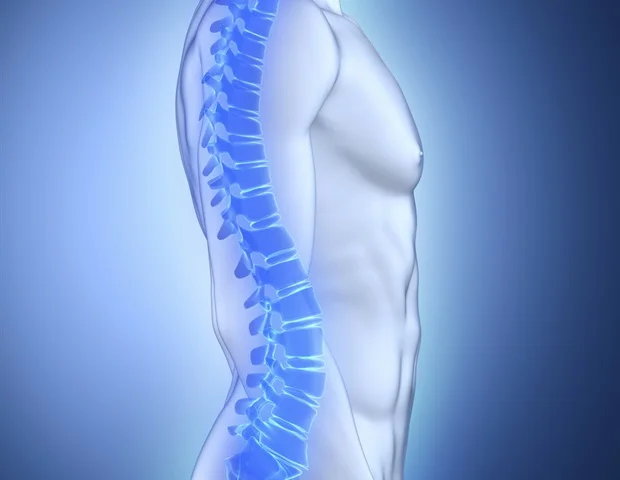
Imagine sustaining a fracture — a genuine structural failure of bone — and feeling nothing. No acute pain. No fall. No obvious moment of injury. You carry on with your morning, your week, your year, entirely unaware that a vertebra in your spine has quietly collapsed. This is not a hypothetical. It is the clinical reality for a significant proportion of patients with osteoporosis, and it is one of the most important — and most underappreciated — aspects of the condition.
Key Takeaways
- Highly Undiagnosed: 2 in 3 vertebral fractures are estimated to be clinically unrecognised at the time they occur.
- Predictor of Future Fractures: There is a 5× increased risk of a further vertebral fracture following an initial one — within just 12 months.
- Escalating Danger: Patients who have had a prior vertebral fracture face a 4× increased risk of sustaining a hip fracture.
Why Vertebral Fractures So Often Pass Unnoticed
The spine’s vertebrae — the stacked, interlocking bones running from the base of the skull to the pelvis — bear the body’s load continuously. In healthy bone, this presents no difficulty. In bone weakened by osteoporosis, the structural integrity of individual vertebrae can be so compromised that the bone simply yields under the ordinary pressures of daily life. Bending to lift a bag. Rising from a chair. Reaching overhead. No dramatic event is required.
When this happens, the vertebra typically collapses inward — what clinicians call a compression fracture. In many cases, the surrounding musculature and the gradual nature of the collapse mean that there is little or no acute pain signal. The body adapts. The patient notices nothing — or attributes a vague ache in the back to tiredness, age, or posture.
“The danger with silent fractures is not just that they go untreated in the moment — it is that they predict the next fracture. An unrecognised vertebral fracture is a warning the patient never received.”
What a Vertebral Fracture Actually Looks Like
The term “fracture” carries an intuitive image — a clean break, an acute injury, immobility. Vertebral compression fractures in osteoporosis rarely present that way. Instead, the vertebral body — the roughly cylindrical block of bone that sits between the discs — loses height. It may wedge at the front, creating a forward lean. It may collapse centrally. It may lose height uniformly. In each case, the spine’s architecture is altered.
- Normal height: vertebra intact, no structural compromise.
- Mild height loss: early compression, often asymptomatic.
- Established fracture: significant height loss; spine alignment affected.
Note: Multiple adjacent fractures can produce the progressive forward curvature — kyphosis — that is often described as a stooped or rounded posture. By the time this is visible, a great deal has already happened to the spine.
The Clues That Are Easy to Miss
Because the acute pain signal is frequently absent, vertebral fractures tend to announce themselves — when they announce themselves at all — through more gradual, easy-to-dismiss signs:
- Often attributed to age: A gradual loss of height — more than 2 cm over time — is a significant finding that warrants investigation, not reassurance.
- Often attributed to posture: A progressively rounded upper back — thoracic kyphosis — may reflect multiple healed vertebral fractures, not simply poor posture habits.
- Often attributed to muscle strain: Persistent mid-back or lower-back ache, particularly in an older individual with risk factors, deserves imaging — not indefinite physiotherapy.
- Often attributed to tiredness: Reduced capacity for sustained physical activity, or a change in gait and balance, may reflect structural spinal change rather than general deconditioning.
Clinical Note
The absence of pain does not mean the absence of injury. A vertebra that has lost height silently is still a fractured vertebra — with all the implications that carries for future fracture risk, spinal alignment, and lung capacity.
It is also worth noting that loss of lung capacity — caused by progressive spinal deformity — is one of the less discussed but clinically significant consequences of multiple vertebral fractures. Some patients experience breathlessness that is attributed to respiratory or cardiac causes before the spinal contribution is identified.
Who Is at Highest Risk
Vertebral fractures do not occur randomly. They arise at the intersection of bone fragility and mechanical load — and certain individuals carry substantially greater risk than others.
Higher Risk:
- Women in the decade following the menopause — the period of most rapid bone loss.
- Anyone with a prior fragility fracture of any kind — including wrist, hip, or rib.
- Individuals who have taken oral corticosteroids for three months or more.
- Those with established osteoporosis (T-score ≤ −2.5) not yet on treatment.
Moderate Risk:
- Individuals with low body weight, significant height loss, or a family history of hip fracture.
- Men over 70 — a population in whom osteoporosis and its fracture consequences are substantially underdiagnosed.
Why Finding Them Changes Everything
The clinical importance of identifying a vertebral fracture — even an old, healed, asymptomatic one — cannot be overstated. A prior vertebral fracture is one of the single strongest predictors of future fracture risk. It materially changes the treatment threshold, the urgency of intervention, and in many cases the choice of drug.
Why this matters clinically:
Under current guidelines, the presence of a prior vertebral fracture — combined with a T-score in the osteoporotic range — typically indicates that treatment should be initiated without delay. Many patients who meet this threshold are not on treatment, because the vertebral fracture was never identified.
A vertebral fracture assessment (VFA) — performed at the time of a DEXA scan — is a low-radiation imaging technique that can detect prevalent vertebral fractures efficiently, at the same appointment. It is not universally performed, and its absence in standard practice is one of the reasons so many fractures go unrecognised.
Put plainly: finding a silent vertebral fracture may well transform a patient from someone who is monitored, to someone who is treated. And in osteoporosis, that distinction frequently determines whether the next fracture — a hip fracture, a further spinal collapse — occurs or does not.
What You Can Do
- If you have been told you have osteoporosis or osteopenia, ask whether a vertebral fracture assessment has been performed alongside your DEXA scan.
- If you have noticed a reduction in height of more than 2 cm — measured against a reliable earlier record — discuss this with your clinician.
- If you have persistent mid-back or thoracic pain, particularly if you are postmenopausal or have known bone fragility, request imaging rather than accepting indefinite symptomatic management.
- If you have had a fragility fracture of any kind — wrist, ankle, rib, shoulder — treat this as a prompt for a comprehensive bone health assessment, not just treatment of the fracture itself.
- If you are on long-term corticosteroids for any condition, your bone health should be actively monitored and protected — not left as an afterthought.
The most dangerous fracture is not always the one that causes the most immediate pain. It is often the one that passes entirely unnoticed — and sets the conditions for the next.
This article is intended for general educational purposes only and does not constitute medical advice. Always consult a qualified healthcare professional for guidance specific to your individual circumstances.

