
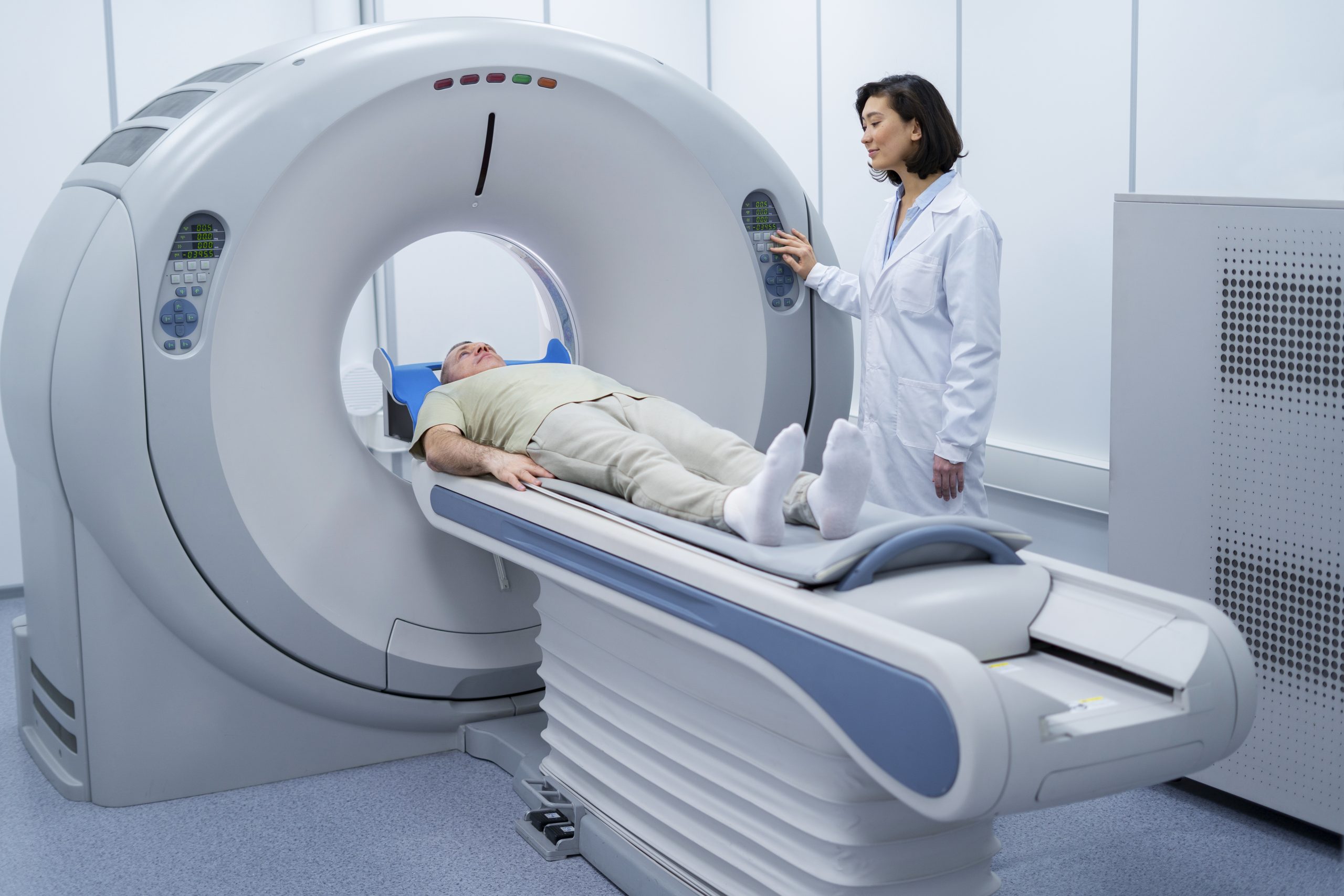
The answer depends on your risk category, whether you are on treatment, and what your last scan showed. For most people taking osteoporosis medication, a repeat scan every one to two years is standard. For those monitoring without treatment, the interval is usually two to five years. This article sets out the clinical evidence behind each recommendation — and identifies the situations where you should scan sooner.
- On osteoporosis treatment: a repeat DEXA scan every 1–2 years is standard to monitor response.
- Osteopenia with no treatment: scan every 2–3 years depending on your fracture risk score.
- Normal bone density with risk factors: every 3 years is typically appropriate.
- Long-term steroid users and those on aromatase inhibitors or androgen deprivation therapy should be scanned annually.
- Certain clinical changes — a new fracture, significant weight loss, a new relevant diagnosis — warrant earlier rescanning regardless of interval.
- You do not need a GP referral to arrange a DEXA scan through the London Osteoporosis Clinic.
A DEXA scan is the gold standard for measuring bone mineral density — but a single scan is only a snapshot. Knowing when to repeat it is what turns a measurement into a clinical tool. If you are unsure whether you are due a scan, or want specialist review of a previous result, you can arrange a DEXA scan in London through our partner facilities, with full interpretation by Dr. Taher Mahmud — no GP referral required.
What a DEXA Scan Measures — and Why Timing Matters
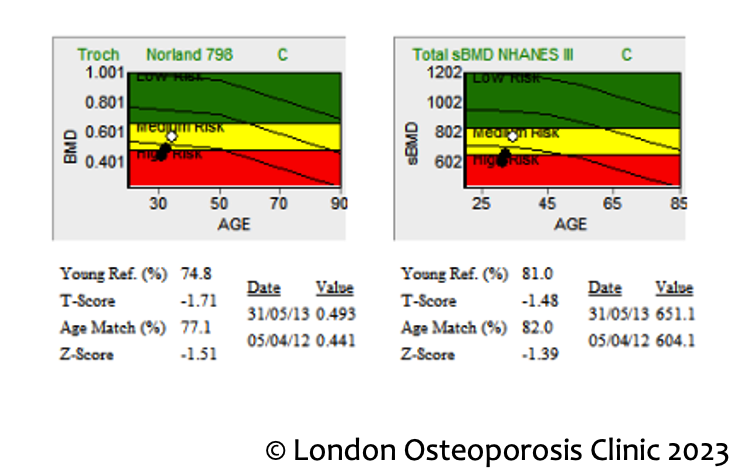
DEXA — Dual-Energy X-ray Absorptiometry — measures bone mineral density (BMD) at two sites: the lumbar spine and the hip. The result is expressed as a T-score: the number of standard deviations your BMD falls above or below the average for a healthy young adult at peak bone mass. A T-score of −1.0 to −2.5 indicates osteopenia; below −2.5 meets the WHO definition of osteoporosis.
The T-score on any single scan tells you where you are today. A repeat scan, taken at a clinically appropriate interval, tells you which direction you are heading — improving, stable, or declining. That trajectory is what drives treatment decisions: whether to start medication, change a drug class, or maintain the current approach with confidence.
Bone density changes slowly. Most DEXA scanners cannot reliably detect meaningful change within fewer than twelve months. Scanning too frequently creates apparent fluctuations that reflect measurement variability rather than genuine biological change, leading to unnecessary treatment adjustments and patient anxiety. Scanning too infrequently, on the other hand, allows clinically significant bone loss to go undetected until a fracture occurs. The intervals recommended below are calibrated to avoid both errors.
How Often if You Are on Osteoporosis Treatment
If you have been diagnosed with osteoporosis and are taking bone-active medication — a bisphosphonate (alendronate, risedronate, ibandronate, or zoledronic acid), denosumab, romosozumab, or teriparatide — the standard recommendation is a repeat DEXA scan every one to two years.
This interval is long enough for treatment-related changes in bone density to accumulate beyond the scanner’s measurement error, yet short enough to detect a poor treatment response before another fracture occurs. A meaningful response to treatment is defined as stable or improving BMD combined with no new fragility fractures. Where BMD continues to fall despite adherent use of first-line treatment, your consultant should consider whether secondary causes of bone loss have been excluded and whether a change of drug class is warranted.
After five years on oral bisphosphonates, NICE guidance recommends formal reassessment of fracture risk. For some lower-risk patients, a planned “drug holiday” may be appropriate if bone density is stable and fracture probability has normalised. That decision is always made on the basis of the repeat DEXA result alongside the full clinical picture — and underlines why consistent follow-up scanning matters throughout any treatment course.
How Often if You Have Osteopenia
Osteopenia — a T-score between −1.0 and −2.5 — means bone is thinner than average but has not yet crossed the osteoporosis threshold. The appropriate monitoring interval depends on your FRAX score (a validated tool estimating ten-year fracture probability), your rate of prior bone loss, your age, and additional clinical risk factors.
For most people with osteopenia and moderate fracture risk, a repeat scan every two to three years is appropriate. This provides enough time for meaningful change to accumulate while giving sufficient warning to intervene if the trajectory is worsening.
Where the T-score is close to the osteoporosis threshold — for example, −2.3 or −2.4 — or where multiple risk factors are present (low body weight, previous fragility fracture, strong family history of hip fracture, early menopause, long-term medication use), the shorter end of this range is preferred. In some cases, annual monitoring is appropriate even without a formal osteoporosis diagnosis. A full bone health assessment, including FRAX calculation, is what determines which applies to you.
How Often if Your Bone Density Is Normal

A normal DEXA result — T-score above −1.0 — is reassuring, but it is not a permanent guarantee. Bone density typically declines at 1–2% per year after menopause and can accelerate to 3–5% annually in the two to three years immediately following menopause onset. A woman with normal BMD at 55 may have crossed into osteopenia or osteoporosis by her early sixties without any symptoms or change in how she feels.
For post-menopausal women with normal bone density and no additional risk factors, the Royal Osteoporosis Society recommends a repeat scan in three to five years — or sooner if clinical circumstances change. For pre-menopausal women with a specific clinical reason for scanning (low body weight, a condition known to affect bone metabolism, long-term medication), the interval should be agreed with a specialist based on the underlying risk factor.
Men with normal bone density are at lower baseline risk but should not be dismissed. Men account for approximately 20% of osteoporotic fractures in the UK, and underlying causes such as hypogonadism, alcohol excess, and long-term corticosteroid use should be excluded before a normal scan result is taken as fully reassuring.
When to Scan Earlier: Clinical Red Flags
Regardless of where you are in your standard monitoring interval, the following clinical changes should prompt an earlier repeat assessment:
- Starting or stopping long-term corticosteroids. Oral prednisolone at 5 mg or more for three months or longer causes predictable and significant bone loss. Baseline BMD should be established at the point of starting, with repeat scanning every 12 months while on treatment. This applies to any oral steroid, not just prednisolone.
- A new fragility fracture. A fracture following a minor fall or impact — wrist, vertebra, hip, rib, or pelvis — is a clinical red flag even if a recent scan showed only osteopenia. Bone density should be reassessed alongside a formal fracture risk calculation and a review of secondary causes.
- Significant unintentional weight loss. Loss of more than 10% of body weight over 6–12 months reduces skeletal loading and is associated with accelerated bone loss, particularly in older adults and those with underlying malabsorption conditions.
- A new relevant diagnosis. Rheumatoid arthritis, coeliac disease, inflammatory bowel disease, hyperthyroidism, hyperparathyroidism, chronic kidney disease stage 3b or above, and liver disease all affect bone metabolism. Each warrants fresh BMD assessment regardless of when the last scan was performed.
- Starting aromatase inhibitors or androgen deprivation therapy. Breast and prostate cancer treatments that suppress oestrogen or testosterone can cause bone loss of 3–5% or more per year. Annual DEXA scanning is standard of care in oncology bone health pathways, and should not wait for symptoms.
Quick Reference: Scan Frequency by Category
- On treatment for osteoporosis: every 1–2 years
- Osteopenia, higher fracture risk (elevated FRAX, multiple risk factors): every 1–2 years
- Osteopenia, lower fracture risk: every 2–3 years
- Normal BMD, post-menopausal or with risk factors: every 3 years
- Normal BMD, no significant risk factors: every 3–5 years
- On long-term corticosteroids (≥5 mg prednisolone for ≥3 months): annually
- On aromatase inhibitors or androgen deprivation therapy: annually
These are frameworks, not prescriptions. Individual factors — the trajectory shown between two previous scans, medication history, comorbidities, and patient preference — all inform the final decision. If you have had a previous DEXA scan elsewhere and are unsure what it means or when to repeat it, bringing the report to a specialist consultation is the clearest way to get a personalised answer.
In clinic, we see two patterns regularly. The first is patients who had a DEXA scan five or more years ago, were told their bone density was “fine,” and assumed nothing further was needed. Bone health is not static — normal at 55 can be osteoporosis at 62, and in those seven years a preventable fracture may have occurred. The second is patients who have been rescanned every few months by a provider without specialist oversight, accumulating anxiety without clinical gain. The right interval is the one that is justified by your current risk profile — and that is what a specialist assessment determines. At the London Osteoporosis Clinic, every scan we arrange through our partner facilities is reviewed in full by Dr. Taher Mahmud, who will explain the result, set the correct monitoring interval, and advise on any treatment indicated. Arrange your DEXA scan through LOC or book a bone health assessment — no GP referral needed.
Frequently Asked Questions
Can I arrange a DEXA scan without a GP referral?
Yes. The London Osteoporosis Clinic arranges DEXA scans through accredited partner facilities across London without requiring a GP referral. Your results are reviewed in full by Dr. Taher Mahmud, who will explain the findings and advise on whether treatment or closer monitoring is indicated. Find out how to arrange your scan.
My last DEXA scan was over five years ago — do I need a new one?
Almost certainly yes, particularly if you are post-menopausal, have started any new medication since then, or have experienced any health changes that could affect bone metabolism. A five-year-old result does not reflect your current bone density. We recommend a consultation to review your full clinical picture before arranging a repeat scan, as your individual risk determines which monitoring interval is appropriate.
How long does it take to see a change on a repeat DEXA scan?
Meaningful change in bone mineral density typically takes 12–24 months to exceed the measurement error of the scanner. This is why annual or more frequent scanning is rarely justified outside of high-risk situations such as long-term steroid use or cancer treatment. Shorter intervals generate apparent fluctuations that reflect scanner variability rather than genuine biological change, and can lead to unnecessary clinical decisions.
I had a DEXA scan at another clinic — can LOC review my results?
Yes. If you have an existing DEXA report — from a private provider, NHS hospital, or international clinic — Dr. Taher Mahmud can review it in the context of your full clinical picture during a consultation. Bring your printed report, any recent blood test results, and a list of your current medications. This gives the clearest basis for a monitoring or treatment recommendation.
Does it matter if I use a different scanner for my repeat scan?
Yes — for monitoring purposes, repeat scans should ideally be performed on the same scanner, or at minimum the same scanner type, and should measure the same skeletal sites. T-scores are not directly comparable between different scanner manufacturers. If you are changing provider for a repeat scan, inform the radiographer of your previous scan details so any cross-calibration differences can be accounted for in the report.
Medically reviewed by Dr. Taher Mahmud, Consultant Rheumatologist and Co-Founder, London Osteoporosis Clinic. Dr. Mahmud has over 25 years of clinical experience in bone health and osteoporosis management.
This article is for informational purposes only and does not constitute medical advice. DEXA scan intervals should be agreed with your GP or specialist based on your individual clinical circumstances. Always consult a qualified clinician before making changes to any aspect of your bone health management.
References:
[1] National Institute for Health and Care Excellence. Osteoporosis: assessing the risk of fragility fracture. NICE Clinical Guideline CG146. 2012 (updated 2017). NICE
[2] Royal Osteoporosis Society. Clinical Guidance for the Prevention and Treatment of Osteoporosis. 2021. ROS
[3] Kanis JA et al. FRAX and the assessment of fracture probability in men and women from the UK. Osteoporosis International, 2008. PubMed
[4] Compston J et al. UK clinical guideline for the prevention and treatment of osteoporosis. Archives of Osteoporosis, 2017. PubMed

